


The auto repair business can no longer run on paper notebooks and phone calls
The auto repair industry has undergone a massive shift over the last decade — in both customer expectations and operational demands. Being a great mechanic is no longer enough. Appointment management, customer communication, financial tracking, and brand image matter just as much as quality repairs. When a car arrives, the process doesn't just happen on the lift — it continues across phones, notebooks, spreadsheets, and WhatsApp threads, and this fragmented workflow eats hours every day.
Auto repair scheduling software exists to bring this chaotic flow into a single digital line. The customer books online, vehicle details are saved to their profile, the technician sees the work order on their device, invoicing and register logging happen in one click when the job is done, and periodic maintenance reminders kick in automatically. Piyzi designed this chain around the real workflows of auto repair shops and continues to refine it constantly.
As a shop owner, three questions tell you everything you need to know. Can you pull up the service notes for the 15 vehicles that came in yesterday? Which customers had tire rotations at your shop this same month last year? Which technician generated the most revenue this month? If the answers don't appear in seconds, your shop needs a digital backbone.
Why does an auto repair shop need specialized software?
Generic scheduling apps can't meet auto repair needs because the vehicle is as much an actor as the customer. Plate number, VIN, mileage, make, and model are data points that must be captured at every service. Generic tools offer none of these fields. The shop owner tries to squeeze everything into a notes field — and searches, reports, and reminders become impossible. Piyzi treats these as first-class data fields from day one.
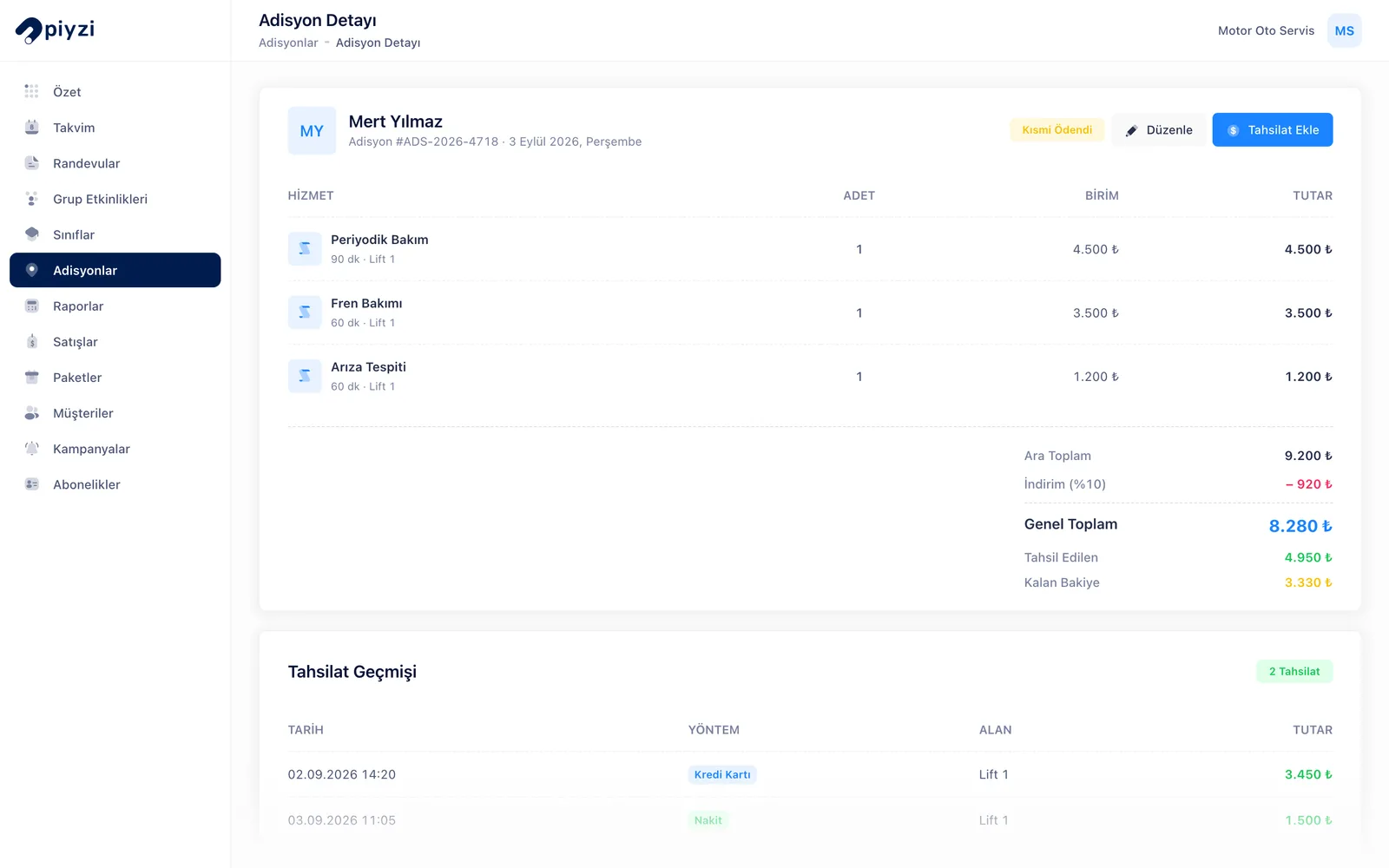
The second difference is the work-order-to-invoice relationship. A service manager creates a work order for a vehicle, then issues an invoice to the customer. If these two documents aren't linked, labor and parts get tracked in two places, errors creep in, and customer trust erodes. In Piyzi, every item you add to the work order automatically flows to the invoice — one record powers both the operational and financial process.
The third critical difference is the periodic maintenance relationship. An auto repair customer isn't a one-time customer — they're expected back every 6 months or every 10,000 km. The only way to make that happen is systematic reminders. Piyzi's periodic maintenance automation is designed precisely for this need and meaningfully boosts repeat customer rates.
The core value Piyzi delivers for auto repair shops
Summarizing Piyzi's value for auto repair in a single paragraph isn't possible. Here are the five most critical points.
- Online booking + vehicle info: When a customer books, they also enter their vehicle's plate, model, and mileage. You know what you'll be working on before they arrive.
- Service history and plate search: Search by plate to pull up the full service record, replaced parts, and notes in seconds.
- Work order and invoice integration: The work order the technician sees and the invoice the customer receives are 100% aligned — error-free and professional.
- Periodic maintenance automation: Automatic reminders triggered by mileage or time — repeat customer rates increase noticeably.
- Financial management on one platform: Cash register, collections, accounts receivable, expenses, and technician bonus tracking on one screen — no separate accounting software needed.
How Piyzi transforms your daily workflow
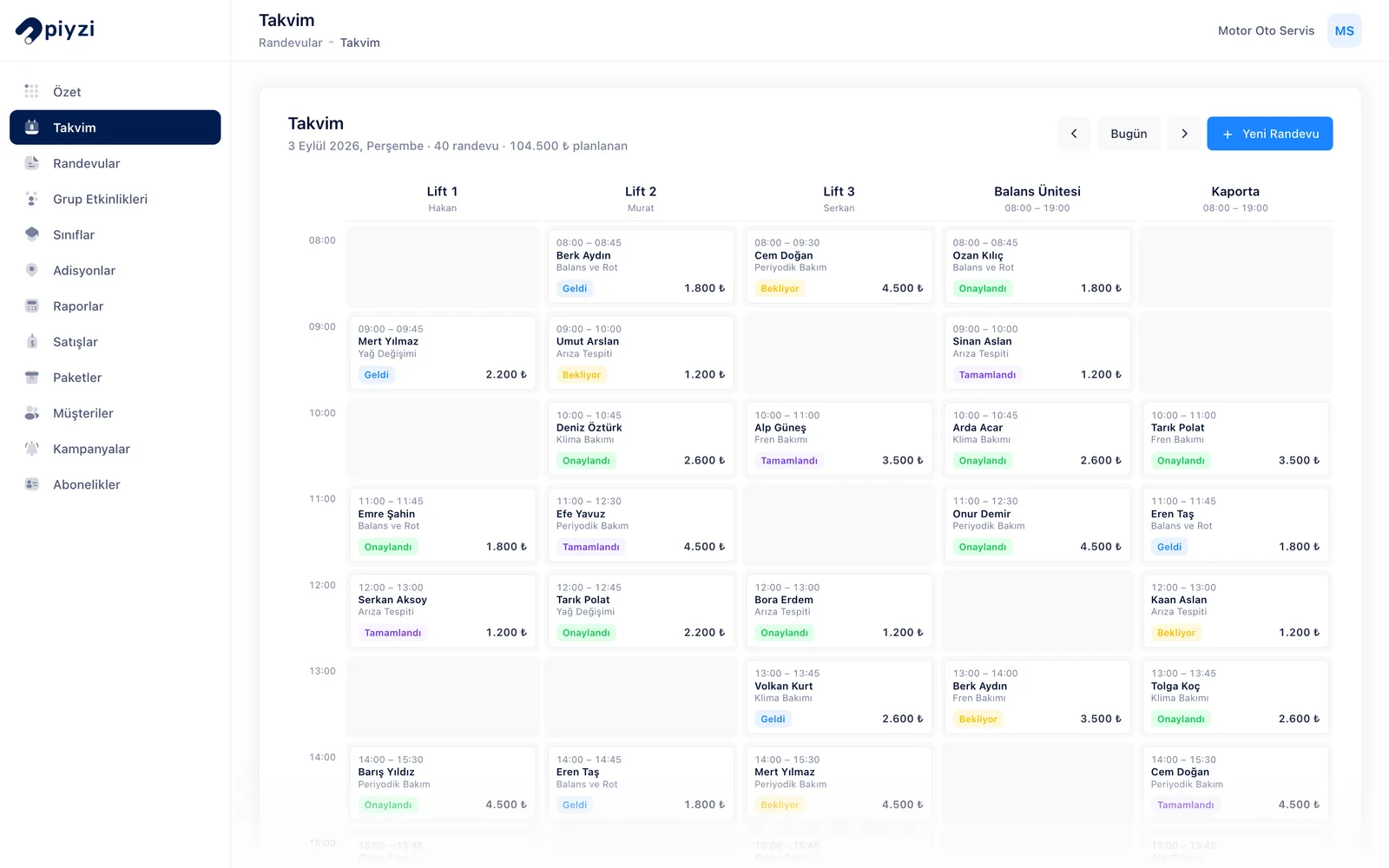
You arrive at the shop in the morning, open the Piyzi dashboard, and the full day's schedule appears. Which vehicle goes on which lift, which technician handles which car, how long each job takes — it's all clear. Overnight bookings from your online page are already on the calendar, so there are no morning calls chasing down customers.
When a customer arrives, you search by plate to open the vehicle profile and see prior service history. The technician pulls the work order from their tablet or phone and gets to work. When the job is done, parts and labor line items convert to an invoice in one click. The customer receives a professional document at pickup, payment is collected, and the register updates automatically. A thank-you message and Google review request go out via WhatsApp.
End-of-day close is one click. How many vehicles came in, which tech handled how many jobs, total revenue, cash-vs-card breakdown, expenses logged — all summarized. Weekly and monthly reports reveal your most profitable services, top-earning technicians, and repeat customer rates. Meanwhile, customers who've hit their mileage threshold get a periodic maintenance reminder automatically — next month's calendar starts filling itself.
The game-changing detail: work orders, vehicle history, and periodic maintenance
90% of auto repair software is just a booking calendar and a customer list. But the real work is linking what was done on the vehicle today to what needs to happen next. In Piyzi, a work order isn't just an attachment to an appointment — it's a key chapter in the vehicle's story. When a technician logs mileage, replaced parts, oil type, and notes during a service, that record is written to the vehicle's profile.
Six months later, when the same vehicle returns, the new technician instantly sees the full history. "Last oil change at 110,000 km, current reading 115,000 km, timing belt check approaching" — this information is calculated automatically and shown as a suggestion. This approach both builds customer trust and makes upselling additional services effortless. The customer trusts you because they feel you know their car better than they do.
Periodic maintenance automation ensures no customer is forgotten. A customer who just had an oil change receives an automatic reminder 5,000 km or 6 months later. This message is more than a simple WhatsApp or SMS — it gives the customer the feeling of being remembered. In the auto repair business, loyalty hides in these small details.
Tangible gains for your repair shop
Here's a quick summary of the measurable changes repair shops see in their first 6 months on Piyzi:
- Incoming appointment volume and repeat customer rates increase noticeably
- Phone chaos and scheduling conflicts virtually disappear
- Work orders and invoices merge — creating a professional, corporate-ready image
- Technician performance is transparently reported — bonus discussions become dispute-free
- Google review count and rating climb with the automated request system
Take your auto repair services to the next level with Piyzi
Competition in auto repair gets fiercer every year. Great repairs alone aren't enough anymore — you need great booking, great communication, great reporting, and a great customer experience. Without the infrastructure to deliver this experience, technical expertise alone can't sustain growth. Piyzi provides that infrastructure for repair shops in a package that's easy to use, designed for the local market, and affordably priced.
Account setup takes 2 minutes. The first 14 days are completely free. No credit card, no commitment. Don't like it? Walk away without paying a cent. But chances are you will like it — because it's a platform refined with feedback from hundreds of auto repair businesses.
Click Start 14-Day Free Trial today, define your services, and book your first online appointment this week. One small decision for your shop can make a serious difference six months from now.
Common concerns from repair shop owners — answered
The first question shop owners ask before switching to Piyzi is usually "Will I lose my existing customer and vehicle data?" No need to worry. Piyzi can import all your customers, plates, makes, models, mileage, and service notes from Excel or CSV in a single upload. Our support team guides you through the migration so years of accumulated data transfers without a single record lost.
The second common concern is team adoption. The idea of "learning new software" can seem daunting for veteran mechanics and technicians. But Piyzi's interface is clean, intuitive, and designed to follow logical workflows — the vast majority of techs are productive from day one. The work order screen works smoothly on touchscreen tablets, which is a big ergonomic advantage for staff working on the shop floor.
The third concern is return on investment. The monthly fee varies by shop size, but a single extra appointment from a periodic maintenance reminder more than pays for it. Most shops recoup their subscription within two weeks through repeat customer revenue — and the rest is pure profit.
The future of auto repair runs on data
The biggest transformation the auto repair industry will see over the next five years is in customer data management. Which vehicles are likely to come in, what each customer needs, which technician excels at which job — answers to these questions will become more critical by the day. Shops that start collecting this data today will be one step ahead when competition intensifies in the years to come.
Piyzi brings this data infrastructure to repair shops today and makes it accessible at an affordable price. As a shop owner, the choice is between seizing this opportunity now or waiting for the market to get harder. The right choice is the one every growth-minded shop eventually makes. If you'd like to take the first step today, you can start by recording incoming vehicles in a standard way with our free vehicle intake form generator.