


What is Pilates studio software?
Pilates studio software runs a studio's three timelines in one place: the instructor and equipment calendar (private sessions and group classes), each member's rights (class pack, unlimited membership, cancellation rights) and the money (collections, receivables, instructor commission). In Piyzi these three timelines are covered by the appointment calendar, the class schedule, the pack and membership modules, a member-facing online page and cash reports.
Who it fits: single-reformer boutique studios, mat and reformer studios with 2-8 instructors, studios that teach both Pilates and yoga, and chains with two or more branches.
Who it does not fit: instructors who only teach one-to-one at home and sell no packs (a diary is enough), studios that charge per class without tracking memberships or packs, and anyone looking for accounting software (Piyzi tracks cash and receivables, it does not keep statutory books).
| Feature | What the studio gains | Piyzi module |
|---|---|---|
| Capacity-controlled group classes | Bookings capped at reformer count, overbooking ends | Classes and group sessions |
| Online class booking | Members pick their class, phone traffic drops | Online booking |
| Class packs and cancellation rights | Every attendance deducts from the right pool, disputes end | Package tracking |
| Unlimited memberships and freezes | Monthly plans, expiry alerts, rule-based freezing | Membership tracking |
| QR attendance | No roll call, absence reports build themselves | QR attendance |
| Instructor commission and cash | Month-end commission in one click, collections and receivables on one screen | Staff commission |
On this page: Booking calendar · Online reservations and cancellation rights · Memberships and packs · Sample weekly schedule · Reformer capacity and levels · Pricing
Pilates booking calendar: private sessions and group classes on one calendar
A Pilates studio works with two units of time: the one-to-one reformer session and the six-to-twelve-person group class. A generic booking tool handles only the first; when you try to record a group class as "an appointment with capacity one", pack deductions, attendance and instructor commission end up being tracked by hand. In Piyzi a private session is opened on the appointment calendar with a service, an instructor, a machine or room, a duration and a customer; a second session for the same instructor at the same time is caught by the conflict check. Group classes live on the class schedule as capacity-controlled sessions.
Both structures share the same customer profile, the same pack pools and the same reminder automations. A member's ten-class reformer pack deducts from the same pool whether they book a private session or a group class; the WhatsApp or SMS reminder goes out under the same rule as the class approaches; the credit is finalised when the class is completed and refunded under your studio's rule when it is cancelled. The "appointment book here, class list there, pack spreadsheet somewhere else" setup collapses into one record. Instructors check their day from their phone, and the owner reads which machine sits idle at which hour from the weekly view.
Online Pilates reservation system: members pick their class, cancellations follow your rules
The reservation page is a web address dedicated to your studio; members sign in with their phone number without installing an app, see the weekly schedule with remaining capacity and book a suitable class. The booking is covered by the member's valid pack or unlimited membership; a member without rights cannot book and a full class accepts no new bookings. You also decide who may book online: open it to everyone, or restrict members with unpaid balances or poor attendance.
Cancellations are where studios argue most, so Piyzi ties them to two rules. The first is the free-cancellation window you define per class: cancellations made up to, say, 24 hours before the class return the credit to the member. The second is the cancellation rights you define when selling a pack: "ten classes, three cancellation rights". A member who cancels after the window gets the credit back by using one right from the pack; once the rights run out the credit is forfeited. When the member presses cancel, the screen states which outcome applies, and remaining rights are visible on the pack screen. The same rule applies when your team moves a class, and staff can record a reason and move it without consuming a right. Because the rule is transparent, the "I still had a right" conversations at the front desk end.
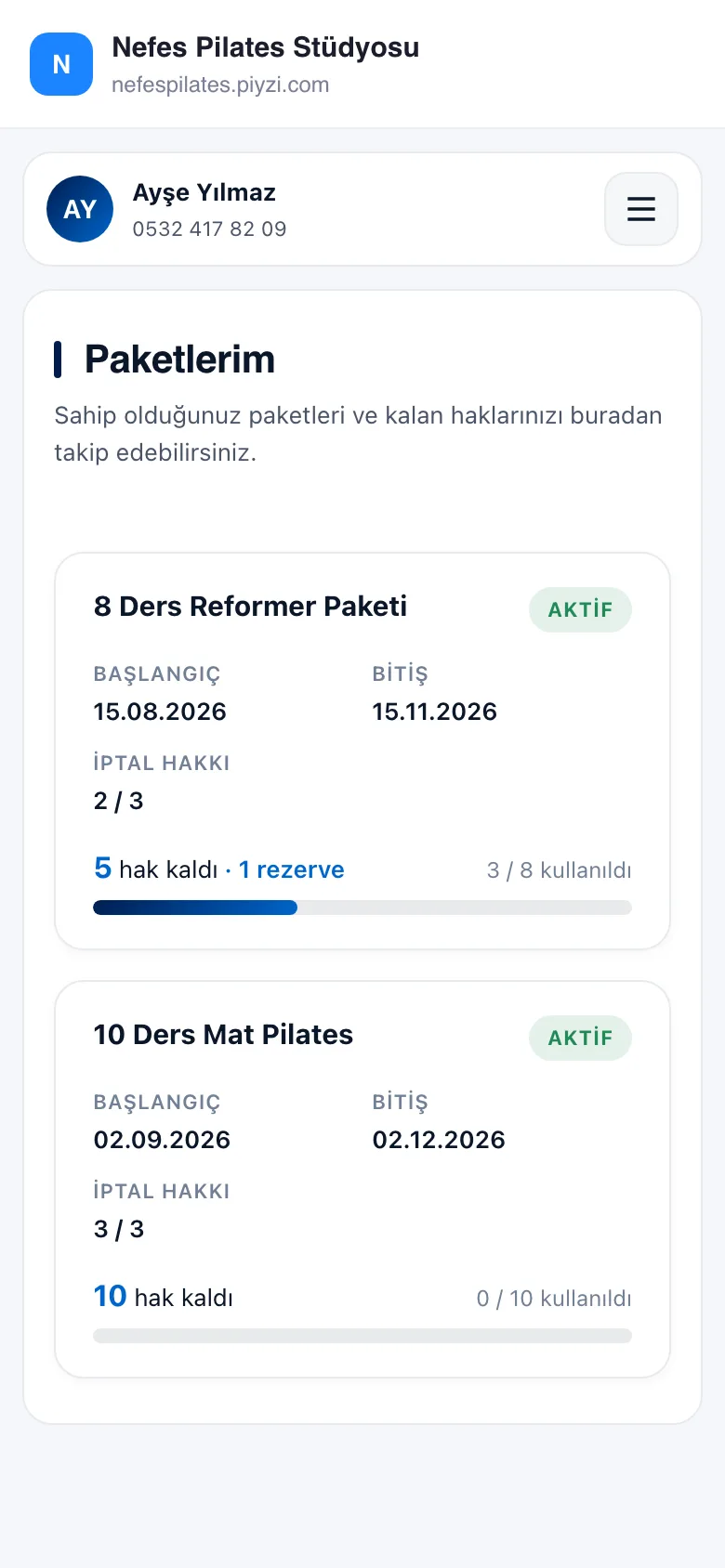
Pilates membership tracking software: class packs, unlimited memberships and freezes
Pilates studios sell in two models at once, and the software must carry both with separate rules. A class pack has a number of credits and an expiry date: an eight-class reformer pack, a sixteen-class mat pack, a twenty-class mixed pack. You define pack templates once and, at the point of sale, adjust the credit count, duration and cancellation rights if needed. Every attendance deducts from the right pool; a mat pack cannot be used for a reformer class. Members get an automatic message as a pack nears its expiry, an expired pack closes and remaining credits show up in reports.
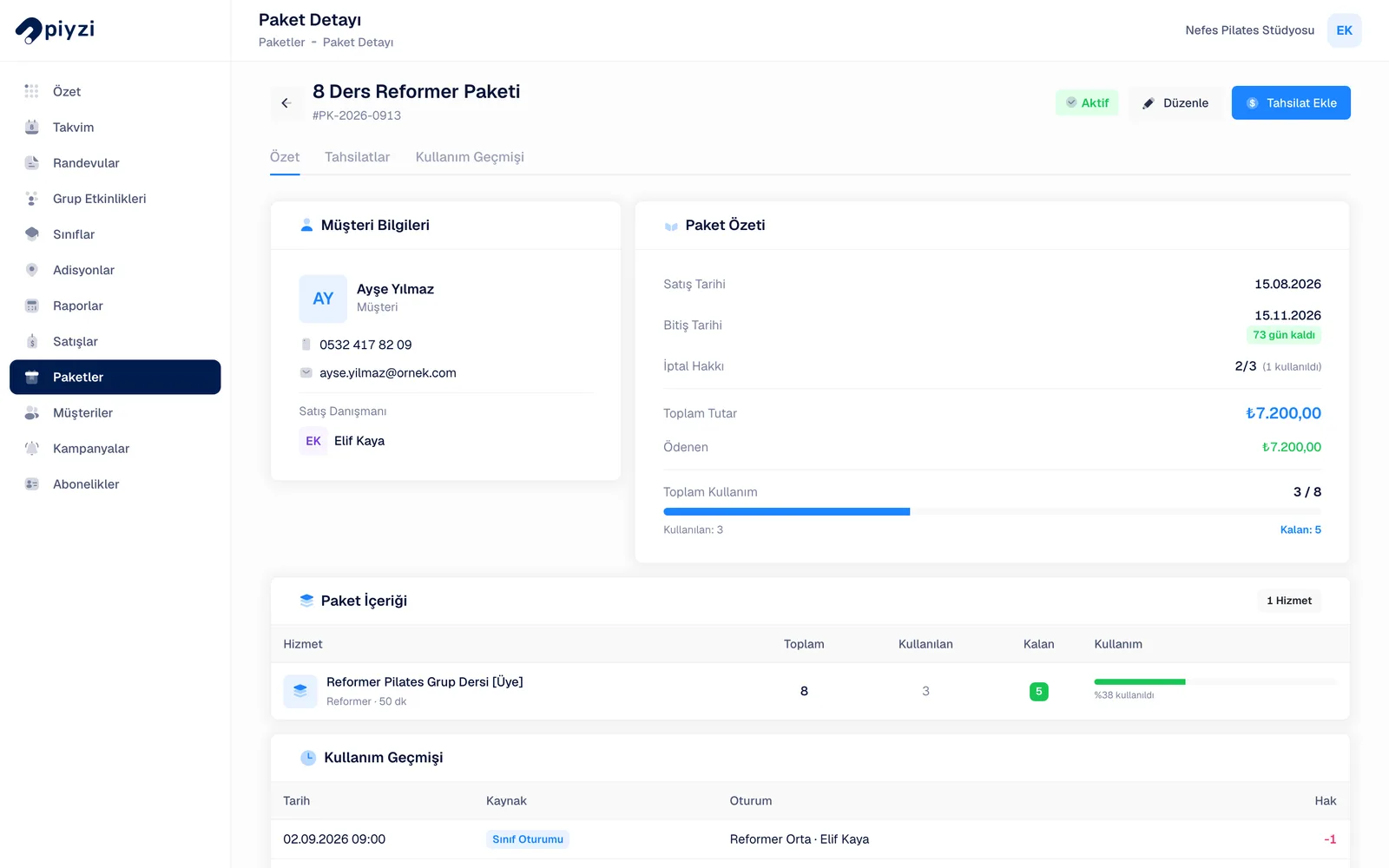
An unlimited membership is time-based: define monthly, quarterly or annual plans and tie the membership to QR check-in. A reminder goes out as the renewal date approaches and an expired membership becomes inactive automatically. Freezing is rule-based on both sides: on membership plans you set the freeze policy (how many days, how many times); on class packs you can cancel a travelling member's upcoming classes and extend the pack, or move their bookings to other sessions. Members see all of it in their online account: remaining credits on packs, remaining days on memberships, upcoming classes. You read from one screen whose credits have run out and whose renewal is due, and collect the payment in the same place.
Pilates studio schedule: a sample weekly class schedule
The weekly schedule is set up once in Piyzi and the system opens the sessions every week by itself. The example below is a typical week for a six-reformer studio with two reformer instructors and one mat instructor; capacities follow the machine count and levels follow the member profile.
| Time | Monday | Wednesday | Friday | Saturday |
|---|---|---|---|---|
| 08:00 | Reformer beginner · 6 | Reformer beginner · 6 | Reformer intermediate · 6 | Reformer mixed · 6 |
| 10:00 | Mat Pilates · 12 | Reformer intermediate · 6 | Mat Pilates · 12 | Mat + reformer workshop · 8 |
| 12:30 | Private session slots | Private session slots | Private session slots | — |
| 18:00 | Reformer intermediate · 6 | Mat Pilates · 12 | Reformer beginner · 6 | — |
| 19:30 | Reformer advanced · 6 | Reformer advanced · 6 | Mat Pilates · 12 | — |
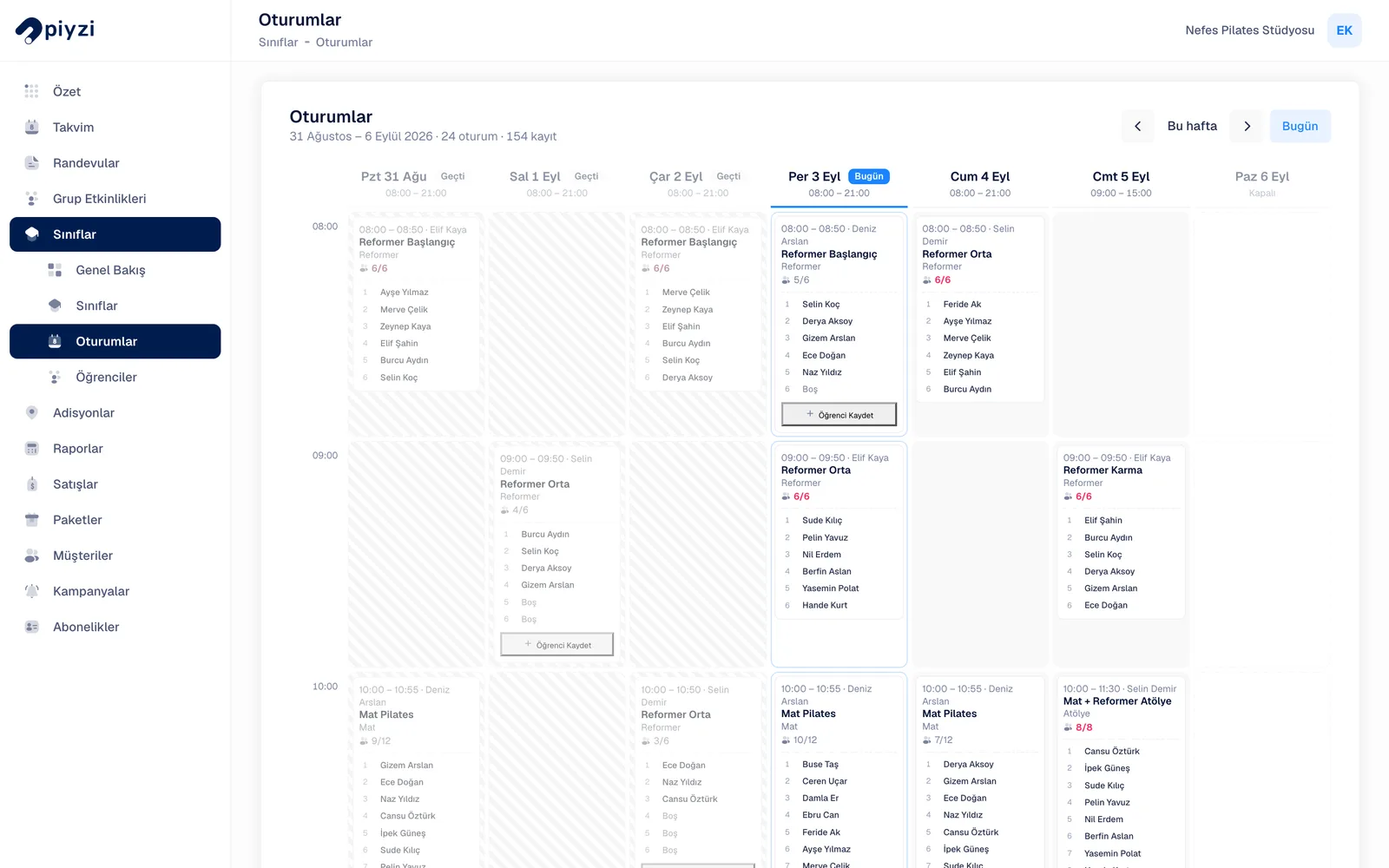
Once the schedule is in place, three tasks remain: freezing that week's sessions in one action for holidays or renovations (enrolled members keep their credits), placing several classes on the calendar at once with the advanced planning tool at the start of a term, and closing the hours where demand drops after reading the occupancy report. Private session slots stay open on the appointment calendar, so members can also book a one-to-one reformer session there from the online page.
Reformer Pilates software: machine capacity and level groups
The reformer class is the class type most tightly bound to physical capacity: with six machines, a seventh booking must never open. In Piyzi capacity is defined per class; a morning reformer class of six, a midday mat class of twelve and an evening private group of four live on the same schedule with different limits. Online booking closes when a class is full, and a booking made at the front desk hits the same limit. If a maintenance week leaves you with five machines, lowering the capacity on that week's sessions is all it takes.
Level groups are the second critical distinction. You tag each class as beginner, intermediate or advanced; instead of mixing two levels at the same hour you plan level-specific sessions and enrol members in the right group. Because reformer, mat, wall Pilates and mixed classes are defined as separate class types, their pack pools are separate too: a member with a ten-class mat pack cannot enrol in a reformer class, while a mixed pack works for both. At the start of class the instructor sees the level and any health note on the participant list; when the class is completed the credit deducts from attendance, and a no-show is recorded with the refund or forfeit applied automatically under your studio's rule.
Where do Pilates studios stand today?
Pilates has become one of the fastest-growing individual fitness disciplines over the past decade. Studios that started with mat classes have evolved into boutique reformer rooms seating 6-8 clients, multi-instructor chains, and hybrid membership programs. But this growth brings operational complexity along with it. The moment a small mat studio adds reformer classes, it faces a rapid cascade of new problems: capacity management, pack differentiation, instructor scheduling, and membership automation.
Most studios try to manage this complexity with spreadsheets, WhatsApp groups, and paper attendance sheets. But when reformer classes hold just 6-8 people, a single overbooking can destroy the in-class experience and member satisfaction. Overbooking, wrong pack deductions, missed membership renewals, and instructor commission disputes -- all of these problems can be solved with one professional Pilates studio software. Piyzi was designed from scratch for the specific needs of Pilates practice.
Why does a Pilates studio need specialized software?
A general-purpose booking tool can handle a mat class, but it inevitably stalls in a real Pilates studio where reformer and mat classes run side by side, multiple instructors teach different client groups, and membership sales intertwine with session packs. That's because a Pilates studio manages three timelines simultaneously: physical capacity (how many reformers, how many mats, how many members), pack/membership credits (how many credits each member has left), and instructor scheduling (who teaches which class and when).
Without a system that integrates these three timelines into one interface, the studio owner spends every day on manual coordination. A class runs about 50 minutes, but spending even 15 minutes total on booking, attendance, pack deduction, and instructor commission for that class adds up and blocks long-term growth. Piyzi links these three timelines into a single structure, letting Pilates studios run with equal efficiency whether they're a single location or a growing chain.
Core value Piyzi delivers for Pilates studios
Piyzi is not just an appointment tool -- it's a platform that unifies every operational layer of Pilates practice. These five building blocks save the most time depending on your studio's size:
- Group Classes & Capacity Management: Set 6-8 person limits for reformer classes and more flexible capacity for mat classes. The system auto-closes enrollment when a class is full or adds members to a waitlist.
- QR Attendance: Members scan their QR code on arrival. Attendance logs automatically. Instructors no longer wrestle with paper lists before class.
- Session Pack Tracking: Manage different pack types -- 10-class mat, 16-class reformer, 20-class mixed -- in separate pools. Each attendance auto-deducts from the correct pack.
- Instructor Scheduling: Each instructor's calendar, commission rate, and performance report are managed individually. Month-end commission calculations finish in one click.
- Member Progress Tracking: Each member's attendance frequency, level notes, and preferred instructor are stored chronologically, enabling you to deliver a personalized experience.
How Piyzi transforms your daily workflow
When you arrive at the studio in the morning, you open the Piyzi dashboard and see all of the day's classes, each class's reservation count, and open spots on one screen. Before the first class, you quickly review the participant list and any special notes (e.g., movements to avoid for a member with a herniated disc). Members scan their QR codes on arrival; attendance is captured automatically. After class, the system auto-deducts from each participant's relevant pack and instantly updates remaining credits.
Throughout the day, new class bookings flow into your calendar from your online page. When a class fills up, new signups automatically join the waitlist. If a member cancels, the first person on the waitlist gets an instant WhatsApp notification -- no slot goes to waste. At end of day, you check the register: the day's payments, new pack sales, and membership renewals in one report. Weekly reports show which classes fill up, when demand dips, and which time slots need attention -- so you optimize your schedule with data, not guesswork.
Tangible gains for your Pilates studio
Here are the concrete results Pilates studios typically see in the first months after switching to Piyzi:
- Reformer capacity is never exceeded; overbooking ends from day one.
- Mat and reformer pack credits are tracked separately and error-free; member disputes end.
- QR attendance shortens pre-class time, generates automatic absence reports, and lets instructors focus on teaching.
- Monthly/annual membership renewal reminders send automatically, significantly reducing churn.
Take your Pilates studio to the next level with Piyzi
Running a Pilates studio requires much more than good instructors and a clean space. The member experience, the ease of the booking flow, the transparency of pack credits, and timely membership renewal reminders all directly determine how fast your studio grows. Trying to scale on spreadsheets and paper roll calls inevitably hits a wall past a certain member count. Piyzi was designed to break through that wall.
Try all features free for 14 days, import your existing member list in seconds, and set up your weekly class template in a single sitting. No credit card required, no commitment -- walk away without paying a cent if it's not for you. But once you start working with Piyzi, going back to manual methods won't feel possible. Now is the time to take your studio to this level. Create your trial account and plan your first class with Piyzi.
Is there free Pilates studio software?
Tools marketed as "free forever" usually come with a limit: a monthly booking quota, a single staff member, reminder SMS and WhatsApp messages billed separately, or ads shown to your customers. As the studio grows, those limits surface within the first months. Piyzi has no permanent free plan; instead it offers a 14-day free trial with every feature open, asks for no credit card and never bills automatically when the trial ends. Start the trial at app.piyzi.com and set up your weekly schedule in a single session.
Studios that teach both Pilates and yoga
If you run yoga classes alongside reformer and mat sessions, both disciplines fit in the same weekly schedule as separate class types with separate pack pools. A member can hold an eight-class reformer pack and a monthly yoga membership at the same time; which right is deducted is decided by the class type, while capacity and instructor planning stay separate for each discipline. For yoga class schedules, workshop registrations and membership models, see the yoga studio software page.