


What is yoga studio software, and who is it for?
Yoga studio software keeps the class schedule, each member's rights and the studio's money in one record: which style, level and instructor teaches when; who holds an unlimited membership and who has how many classes left; who registered for which workshop and how much they paid. In Piyzi these are covered by the class schedule, the appointment calendar, the membership and pack modules, Group Events, a member-facing online page and cash reports.
Three studio profiles, three ways to use it:
- Single-instructor shala: 8-12 classes a week, mostly unlimited monthly memberships; an online schedule, QR attendance and renewal reminders are enough.
- Multi-instructor studio: Hatha, Vinyasa, Yin and Ashtanga in the same week; instructor-based calendars, pack pools per class type, instructor commission and occupancy reports are needed.
- School running teacher trainings (YTT): a 200-hour programme opens as a multi-day event, with capacity and deposit tracking in the Group Events module.
Who it does not fit: instructors who only teach one-to-one at home and sell no packs, studios that charge per class without tracking memberships, and anyone looking for accounting software (Piyzi tracks cash and receivables, it does not keep statutory books).
| Need | How Piyzi covers it |
|---|---|
| Weekly schedule by style, level and instructor, online registration | Classes and group sessions + online booking |
| Unlimited monthly membership, freezing, QR check-in | Membership tracking + QR attendance |
| 10- and 20-class packs, cancellation rights, expiry alerts | Package tracking |
| Workshop, retreat and teacher-training registration with deposit tracking | Group Events module |
| Instructor commission, cash, occupancy and customer reports | Staff commission + cash register |
On this page: Class schedule and online booking · Yoga booking calendar · Membership or pack · Workshops, retreats, teacher trainings · Management and reports · Pricing
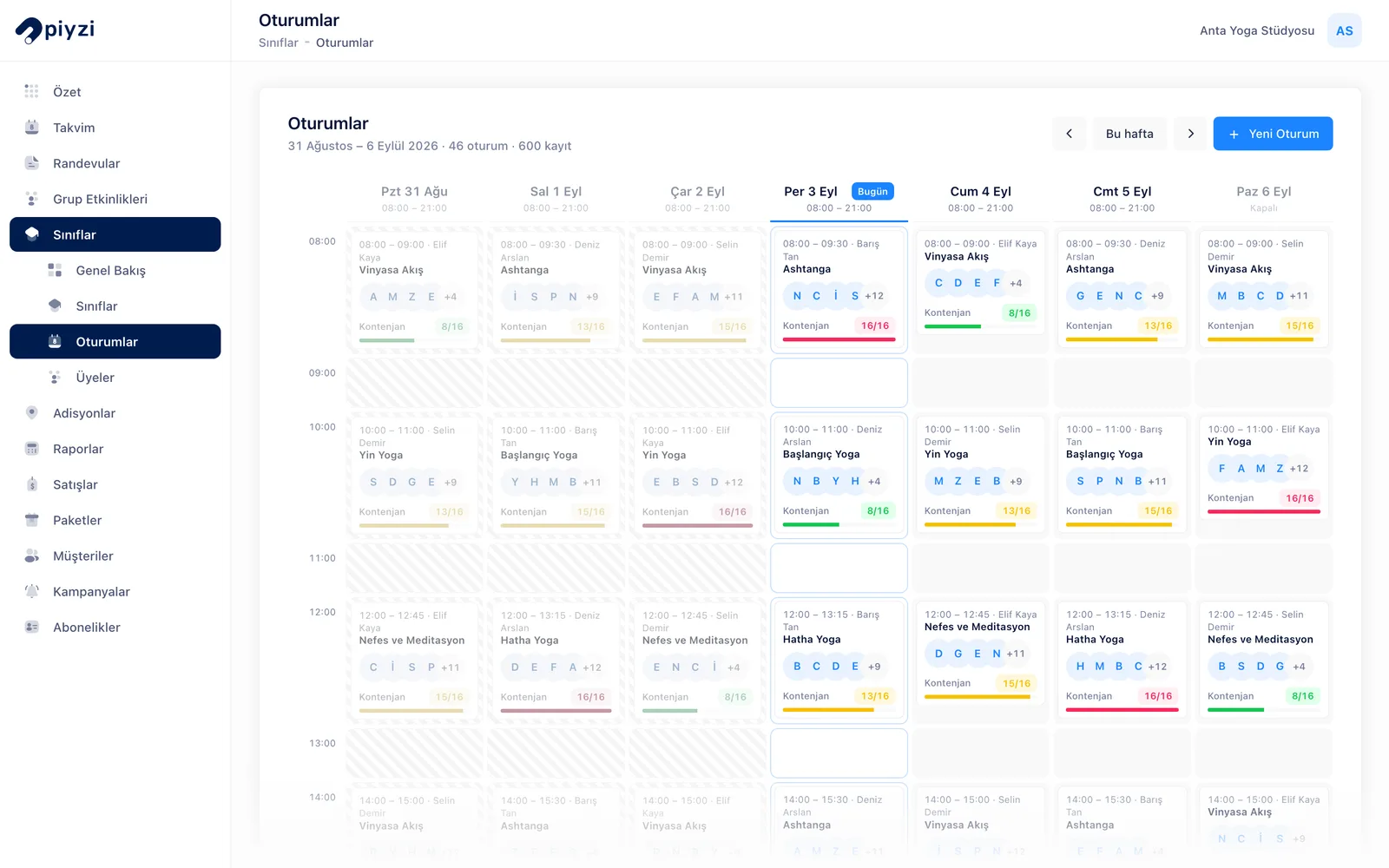
Yoga class schedule and online booking: style, level and instructor on one calendar
The difficulty of a yoga schedule is not the number of classes but their variety: four styles, three levels and five instructors can share one week. In Piyzi every style is defined as its own class with a level, an instructor, a room capacity and a colour. You set up the weekly template once and the sessions open every week by themselves; on holidays or during renovations you freeze that week's sessions in one action and enrolled members keep their credits. The schedule below is a typical week for a two-instructor studio.
| Time | Monday | Wednesday | Friday | Saturday |
|---|---|---|---|---|
| 07:30 | Ashtanga Mysore · advanced · 12 | Vinyasa · intermediate · 14 | Ashtanga Mysore · advanced · 12 | Vinyasa · all levels · 16 |
| 10:00 | Hatha · beginner · 14 | Hatha · beginner · 14 | Prenatal yoga · 8 | Monthly workshop · 16 |
| 12:30 | Private session slots | Private session slots | Private session slots | — |
| 18:30 | Vinyasa · intermediate · 16 | Yin · all levels · 14 | Vinyasa · intermediate · 16 | — |
| 20:00 | Yin · all levels · 14 | Hatha · intermediate · 14 | Restorative · 12 | — |
Members see this schedule on your studio's own online page with style, level, instructor and remaining capacity; they sign in with their phone number and book, and the booking is covered by a valid pack or an unlimited membership. A full class accepts no booking. Cancellation follows two rules: the free-cancellation window you set per class (24 hours before the class, for example) and the number of cancellation rights you define when selling a pack. A member who cancels inside the window gets the credit back; after the window one right is deducted from the pack; with no rights left the credit is forfeited. The member reads that outcome on the cancellation screen, and the argument at the front desk is over before it starts.
Yoga booking calendar: private sessions and group classes together
Besides group classes, yoga studios teach one-to-one private sessions, prenatal and therapeutic work. These open on the appointment calendar with a service, an instructor, a room, a duration and a member; a second session for the same instructor at the same time is caught by the conflict check. Members also book private sessions from the online page by seeing the instructor's free hours. Group classes live on the class schedule as capacity-controlled sessions, and both structures share the same member profile, the same pack pools and the same reminder automations.
In practice that means a member's ten-class pack deducts from the same pool whether they join the Vinyasa group or book a private session; the reminder goes out under the same rule as the class or session approaches; the credit is finalised when the class is completed and your rule applies on cancellation. Instructors see their day, the participant list and any health notes (back, neck, pregnancy) on their phone. The owner drops the "group class book here, private session diary there" setup and reads from one calendar which room sits idle at which hour.
Unlimited monthly membership or class pack? Both together, with rule-based freezing
Most yoga studios sell both models. An unlimited membership is time-based: define a monthly, quarterly or annual plan and tie the membership to QR check-in. A reminder goes to the member as the renewal date approaches and an expired membership becomes inactive by itself. You write the freeze rule on the plan: the minimum days, the maximum total days and how many times. When a member travels, your team freezes the membership, the end date moves forward by as many days, an expired freeze is lifted automatically and past freezes are listed on the membership card.
A class pack carries a credit count and an expiry date: a ten-class Hatha pack, a twenty-class mixed pack. You set up pack templates once and adjust credits, duration and cancellation rights at the point of sale if needed; every attendance deducts from the right pool and the member gets an automatic message as the pack nears expiry. The same member can hold an unlimited membership and a workshop pack at once; the class type decides which right is deducted. Members see all of it in their online account: remaining credits on packs, remaining days on memberships, upcoming classes. You read from one screen whose credits have run out and whose renewal is due, and collect payment in the same place.
Workshops, retreats and teacher trainings: the Group Events module
Everything outside the weekly schedule lives in the Group Events module: a two-hour weekend workshop, a three-day retreat, a 200-hour teacher training, a monthly satsang. You define a start and end date (multi-day is fine), minimum and maximum participants, a per-person or fixed price, an instructor and a room. When you open online registration the event appears on your studio's page; whether to show remaining places, how many hours before the start registration closes, whether registrations are confirmed automatically and whether the event is open only to existing members are your choices.
The participant list is where payments are tracked: each registration shows the amount paid, the remaining balance and a status (unpaid, partial, paid); a participant who left a deposit is marked partially paid and the balance is collected on the day. Payment is taken at the studio in cash, by card or by bank transfer and recorded in the system; the module does not take online card payments, and we say so plainly. A reminder goes out before the event by WhatsApp or SMS; a recurrence rule handles monthly events; for classes taught online, a Google Calendar and Meet link is attached to the event.
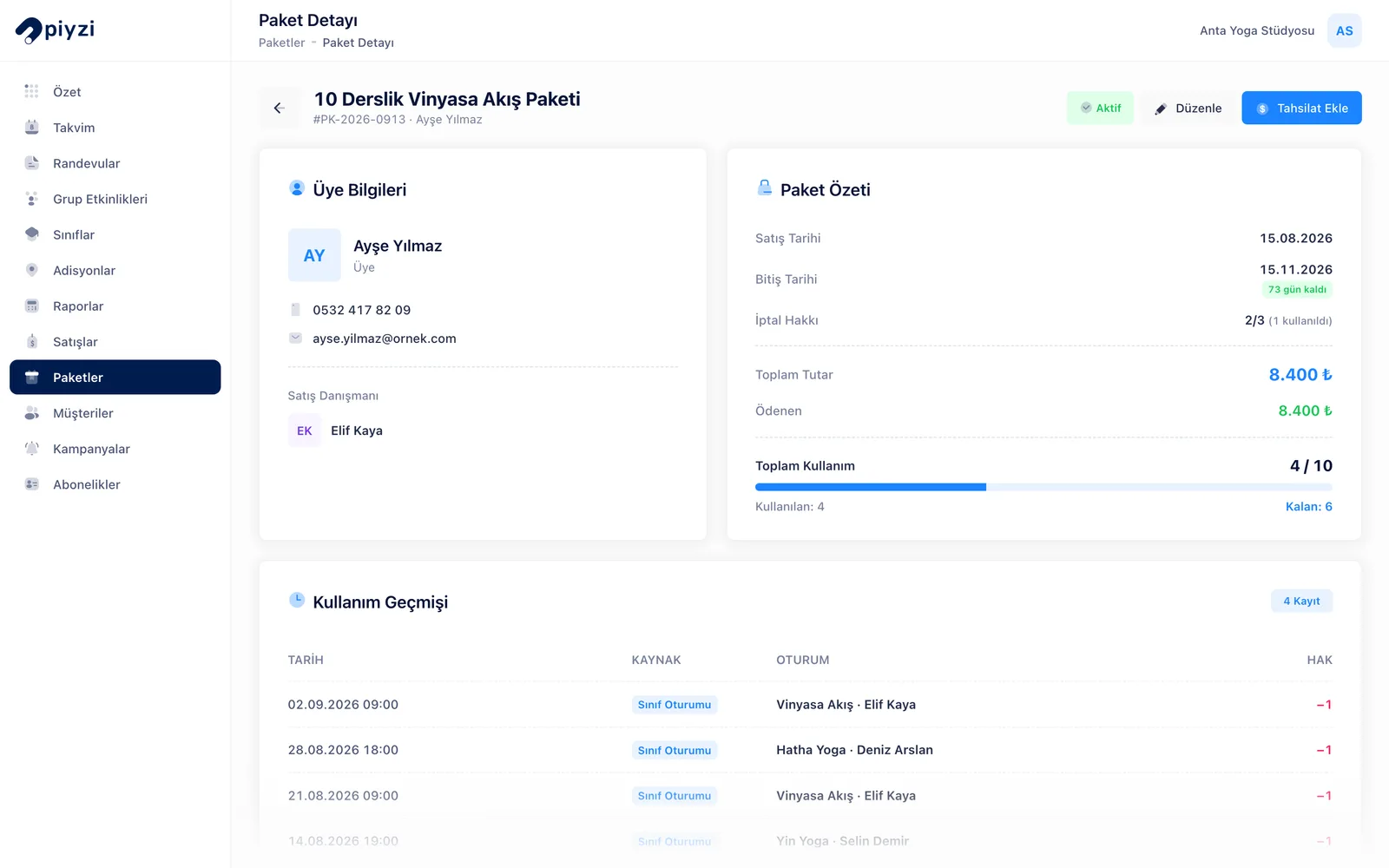
Management: instructor commission, cash and reports
On the instructor side every class has an instructor and a per-class commission rate; at month end the instructor report shows how many classes they taught, how many participants they gathered and the commission they earned, in one click. On the cash side, membership, pack, private session and event collections land in one register, receivables are listed separately and end-of-day and monthly reports come ready. The occupancy report shows which style fills at which hour and which class stays empty, so you change the schedule on data.
Your team gets an iOS and Android app: instructors open the participant list and take attendance from their phone, the front desk records payments on the go. You move your member list from Excel or CSV with the import wizard; duplicate phone numbers are skipped and no automated message is sent during import. Packs and memberships are created from your studio's templates and entered for existing members as sales with their remaining credits; that takes a few hours on the first setup and runs by itself afterwards.
Studios that teach both yoga and Pilates
If you also run mat or reformer Pilates classes, both disciplines fit in the same weekly schedule as separate class types with their own capacity. Reformer classes are capped at the machine count, yoga classes at room capacity; members book both class types from one profile and pack and membership rights deduct by class type. For reformer capacity, level groups and pack pools, see the Pilates studio software page.
Is there free yoga studio software?
Tools marketed as "free forever" usually come with a limit: a monthly booking quota, a single staff member, reminder SMS and WhatsApp messages billed separately, or ads shown to your customers. As the studio grows, those limits surface within the first months. Piyzi has no permanent free plan; instead it offers a 14-day free trial with every feature open, asks for no credit card and never bills automatically when the trial ends. Start the trial at app.piyzi.com and set up your weekly schedule in a single session.